'I call out to all lineage Masters past and present,
Especially the original seven Shambala Masters,
And the twenty-five Kalkins of Shambala.
Especially I call to Suchandra, who first received this king of tantras,
And to Pundarika, who wrote the extensive commentary.
By the power of the auspicious qualities of these Masters,
May all of our hindrances and imperfections fade away
And goodness and joy increase like the waxing moon,
Giving rise to a festival of wonder and glory.
From 'An aspiration to fulfil the stages of the glorious Kalachakra
path'
by the first Panchen Lama, translation Glenn Mullin [12]
At the request of King Suchandra of Shambala
(the first king of Shambala of any importance), Shakyamuni Buddha took
on the form of the Kalachakra deity with the consort Vishvamata, and
gave these highest of teachings to a great assembly of sages and gods
in southern India, at the Stupa of Dhanyakataka. Legend has it
that on request of people during a famine, the third Buddha of this
aeon (the predecessor of Shakyamuni) let fall a shower of rice, which
formed this stupa.
While teaching the tantra, Shakyamuni manifested the entire Kalachakra
mandala in its full 3D form. Furthermore, a second mandala called
the Glorious Constellation Mandala appeared on the ceiling which represented
the cosmos with planets and comets. Interestingly (possibly to symbolise
the relativity of time), the entire initiation took place within a finger-snap,
whereas nowadays it takes three full days to complete.
| |
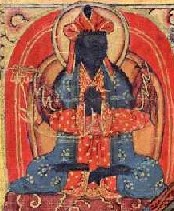
| Suchandra |
| |
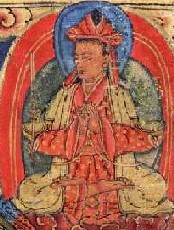
| Manjushrikirti |
| |
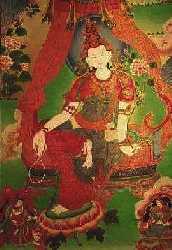
| Pundarika |
| |
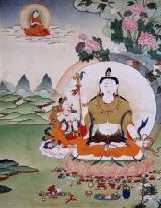
| Anantajaya |
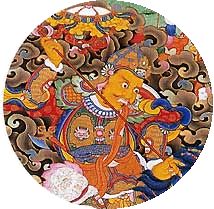 |
| Raudra Chakrin |
King Suchandra, who is said to be a manifestation of Vajrapani (a Buddha-form
who represents the power of all the Buddhas) came from his home north
of Kashmir to receive the teachings, accompanied by 96 generals and
chieftains of the 96 minor kingdoms within Shambala. After the teachings,
he wrote them down and composed the 'Mula' or 'Root Text' of the Kalachakra
tantra, comprising 12,000 verses. This text has never reached us, although fragments are found in other texts.
The root tantra reads: "Then Vajrapani's emanation, King Suchandra from famous Shambhala, miraculously entered into the splendid sphere of phenomena. First he circumambulated to the right, then he worshipped the teacher's lotus feet with flowers made of jewels. Placing his hands together, Suchandra sat before the perfect Buddha. Suchandra requested the Buddha for the tantra, redacted it, and taught it too."
In this root tantra Suchandra was the first of a line of seven religious kings who taught
the Kalachakra to the inhabitants of Shambala (see image on the right).
On the request of Shakyamuni, he built a huge 3-dimensional Kalachakra
mandala in the centre of the kingdom. 2 Years after he received the
Kalachakra teachings he died and was followed by 6 Kings, each reigning
100 years over Shambala, "the Land Held by Shiva".
The first 7 kings are called the 7 Dharma-Kings:
These first names in the lineage lists below are from [9].
NR. Sanskrit, Tibetan, (Life - BCE), English
(0. Nyime Ö - father of Suchandra)
1. Suchandra, Dawa Zangpo (878-876) "Good Moon" (Tibetan)
(See image on the right.)
2. Devendra, Lhayi Wang (876-776) Fond of Sentient Beings,
Fusion of the Supreme
3. Tejasvin,Taji Ziji Chän (776-676) Bearer
of the Dharma Wheel and the Auspicious conch.
4. Chandradatta/Somadatta, Dawä Jin (676-576)
Lord of Speakers
5. Deveshvara/Sureshvara, Lhaji Wangchug (576-476)
Destroyer of the City of Delusion
6. Chitrarupa/Vishvamurti, Natshog Zug (476-376)
Conquerer of False Leaders, Holding a lotus
7. Devesha/Sureshana, Lhayi Wangdän (or Päldän?)
(376-276) Cutter of Delusion, Uprooter of Karma and Klesha.
The following kings have the title "Kalki" ("Kulika" may be an incorrect
spelling) or "Rigden"-kings; meaning "Holder of the Castes" or the Shambala's
Knowledge Holders.
The long English names are from [3].
Nr (Kalki) Sanskrit, Tibetan (Life time), English
(Nr.)
8. (1) Manju Yashas/Manjushrikirti/Manjughoshikirti
(Skt), Jampäl Dragpa (Tib)(Jamyang Drag(Tib) (276 - 176 BC) The
Renowned and Glorious Gentle One (See image on the right)
9. (2) Pundarika, Päma Kar
(po) (176-76 BC) White Lotus, Cherished by the Lord of Potala
(see image on the right)
10. (3) Bhadra, Zangpo* One who Rules
by the Thousand-spoked wheel
11. (4) Vijaya, Namgyäl* [3] (Nampar Gyäl)
Attractor of Wealth, Victorious in War
12. (5) MitrabhadraSumitra, Shenyen Zangpo
(327-427) Integrator of Method and Wisdom, Victorious over Samsara
13. (6) Ratnapani/Raktapani, Rinchen Chag
(427-527) Holder of the Blissful Vajra and Bell
14. (7) Vishnugupta, Kyabjug Bäpa (527-627)
Smiling Holder of the Trident and Rosary
15. (8) Suryakirti/Arkakirti, Nyima Drag(pa)
(627-727) Annihilator of Wild Demons
16. (9) Subhadra, Shintu Zangpo (727-827)
Holder of the Sword and Shield
17. (10) Samudra Vijaya, Gyatso Namgyäl
(827-927) Annihilator of all types of Devils
18. (11) Durjaya/Aja, Gyälka (927-1027) Who
binds with Unbreakable Iron Chains
The lineage comes
to India:
19. (12) Surya/Suryapada, (Wonang) Nyima (1027-1127)
All-Pervading, Radiant Jewel Light
20. (13) Chitrarupa/Vishvarupa,
Natshog Zug (chän) (1127-1227) Holder of the Vajra Prod and
Noose
21. (14) Chandraprabha, Shashiprabha, Da (wäi) Ö
(1227-1327) Lord of Secret Mantras, Holder of the Wheel and Conch
22. (15) Anantapada, Thayä (Nyen) (1327-1427) Holder
of the Mallet that Crushes False Ideas, and the Lotus
23. (16) Parthiva, Mahipala, Sakyang [3: Sakyong) 1427-1527)
(Holder of the Cleaver that Cuts the Bonds of Ignorance, and the Skullcup
24. (17) Shripala, Pälkyong (1527-1627) Annihilator
of the Host of Demons
25. (18) Singha, Senge (1627 -1727) Who Stuns the
Elephant with his Vajra
26. (19) Vikranta, Nampar Nön (1727 - 1827) Subduer
of the Mass of Foes, the Inner and Outer Classes of Devils 27. (20) Mahabala, Tobpo Che (1827 - 1927) Who Tames all
the False Leaders by Means of the Sound of Mantra 28. (21) Anirodha/Aniruddha, Magag Pa (1927 - 2027)
Who Draws and Binds the Entire Three Worlds - Current Ruler
of Shambala
29. (22) Narasingha, Miyi Senge (2027-2127) Ruling by
the Wheel, Holding the Conch
30. (23) Maheshvara, Wangchug Che(npo) (2127-2227) Victorious
over the Armies of Demons
31. (24) Anantajaya, Thayä Namgyäl (2227-2327)
Holder of the vajra and Bell (See image
on the right)
32. (25) Raudra Chakri/Rudra Chakrin, Dragpo Khorlo
Chan or Rigden Dragpo, or Trakpo Chakkhorchen (2327 - 2427,
defeat of barbarians in 2424) Wrathful One with the Wheel. (See
image on the right)
... during the life of Trakpo Chakkhorchen, all of Jambudvipa {the
earth} will be divided in to 24 sections and will be ruled by him. After
that, his two sons Tsangpa and Lhawang will each rule over 12 of those
sections of Jambudvipa. These two will propagate Kalachakra throughout
both halves of Jambudvipa. ... After them will come Ö Sung and
other kings, who will rule the many sections of Jambudvipa and will
gradually bring about the flourishing of Kalachakra. [11]
*: Bhadra and Vijaya will reign a total of 403 yrs [5]
The 8th king, Manjushrikirti was an incarnation of Manjushri
and he put the Kalachakra teachings in a condensed and simplified form,
called the "Sri Kalachakra". He founded a second line of 25
Kings. He also converted a group of non-Buddhist Brahman priests
of Shambala to Buddhism and gave them the Kalachakra initiation to unite
all inhabitants into one "vajra family" - or family of tantric
practitioners.
The 9th king, Pundarika or "White Lotus" was an incarnation of
Avalokiteshvara, and he wrote a commentary called "Vimalaprabha"
(Skt.) or "Stainless Light". The Sri Kalachakra and the Vimalaprabha
together comprise all the source texts of the Kalachakra system. All
other available texts are commentaries to these root texts.
PROPHECIES
IN THE KALACHAKRA TRADITION
Several of the prophecies in the Kalachakra tradition are now already in the
past, for example:
- The 8th king of Shambala, Manjushrikirti (living in the second
century BCE) predicted the coming of the "barbarian Dharma"
after 800 years (about 600 CE).
- During the reign of the 21st. king,
Aniruddha (1927-2027), Buddhism and the Kalachakra will have
nearly come to an end in Tibet, Mongolia, China and much of Asia. This
could certainly be said to be accurate! For example, after the Chinese
invasion in Tibet in 1959 and the destruction of nearly all monasteries
afterwards, the master Ven. Kirti Tsenshab Rinpoche was the only remaining
Tibetan master holding the lineage of the Vimalaprabha (the 'Stainless
Light' commentary); which is one of the only two main Kalachakra texts.
This trend of degeneration is said to continue until the incarnation
of Manjushri and of the Panchen Lama, Rudra Chakrin, comes to
the throne in 2327 (or 2424 [5]). Then, the main prophecy of the Kalachakra tantra is described as:
"The cakravartin shall come out at the end of the age, from
the city the gods fashioned on mount Kailasha. He shall smite the
barbarians in battle with his own four-division army, on the entire
surface of the earth. ... Raudra Kalki shall smite Krinmati .... then
they shall go to the city the gods fashioned on Mount Kailasha where
Cakri lives. At that time, all the families of men on the earth shall
be fulfilled with dharma, pleasure and wealth. Grain shall grow in
the wild and the trees shall bow with fruit - these things will occur.
"[8]
In this way, a golden age throughout the world at the end of the current
'Time of Strife' will be established.
The texts describe that he will come with 'flying ships' (obvious
in our age, but certainly not when these prophecies were written) to
help us out of spiritual darkness, and afterwards the teachings of the
Buddha will survive for another 1,800 [4] or 1,000 [7]
years.
More detailed information can be found in the website of
Alex Berzin (from [6]):
'In the Kalachakra teachings you find a whole discussion of history,
in which you have at various periods invasions. There are various,
what are described as "savage hoards", who come and try to destroy
civilization and all opportunities for people to follow spiritual
paths. Some examples are the invasions from central Asia to India,
wiping out the possibilities for practicing Hinduism and Buddhism;
the Mongols and the Muslims etc. There is a prediction in the Kalachakra
that there will be likewise a great invasion and a great war in the
future. This war will take place in 2424. This is not the type of
war that will destroy the planet, but it will probably be a pretty
bad war. But at that time, the King of Shambhala will come as the
good guy; the bad guys lose and the so called Golden Age is established.
Now one of the very interesting things in the Kalachakra teachings
is a great deal of social comment about what to do at the time of
the invasion; how to prevent it and what are the causes. For example:
we should look at our customs and also at the customs of those who
want to destroy our civilization If they act very similar, then our
children will see little difference between the parents and the invaders,
and they will accept their ways easily. If our first reaction to a
threat is war and violence, the invaders will do the same. Also the
Kalachakra warns for what happens if the astronomy is very much in
the hands of "experts" and nobody else understands it anymore: then
the invaders can change the tables etc., and nobody would notice it.
This can also be very relevant to our own time of computers. The younger
generation depends so much on calculators and computers, they don't
even know how to multiply and divide...'
BIBLIOGRAPHY
[1]: Kalacakra Sadhana
and Social Responsibility, David Reigle, Spirit of the Sun Publications
1996.
[2]: An Introduction to the Kalachakra, Geshe Wangdrak
(losang Tenzin) Part of paper printed for the 1994 Kalachakra initiation
by HHDL in Lahaul, Spiti.
[3]: Kalachakra Initiation, Madison 1981
[4]: The Way to
Shambala by Eric Bernbaum
[5]: Path of the Bodhisattva Warrior by Glenn H. Mullin
[6]: Introduction to Kalachakra, commentary by Dr.
Alex Berzin June 28 - 30, 1985 at Institut Vajrayogini, France
[7]: The Wheel
of Time Sand Mandala, by Barry Bryant, Harper Collins 1995, ISBN
0-06-250088-0
[8]: The Outer Wheel
of Time; Vajrayana Buddhist cosmology in the Kalacakra tantra,
by John Ronald Newman, Univ. of Wisconsin 1987 (order number 8723348)
[9]: Kalachakra,
by Namgyal Monastery, Tibet Domani, Italy1996
[10]: The Inner Kalacakratantra,
A Buddhist Tantric View of the Individual, by Vesna A. Wallace (Oxford
University press, 2001)
[11]: A Summary of How the Abhisheka and Practice
of Shri Kalachakra Was Propagated in India and brought to Tibet. From
a booklet distributed during the Kalachakra initiation by His Eminence
Jamgon Kongtrul Rinpoche in August 1990, Toronto.
[12]: The Practice
of Kalachakra by Glen H. Mullin (Snow
Lion 1991)
LINKS
StudyBuddhism.com