The Buddha defined time as "the measurement of change". This is not
too remote from a definition of some scientists (like Albert Einstein)
who said that time is "what a clock measures". In that sense,
one could view Kalachakra (Time-cycle) as cycles of change, changes
towards our spiritual development into a Buddha. Time has no beginning
or end in Buddhism, as all things (except the state of Enlightenment)
undergo constant change. And, as mentioned in [9], 'just as the cosmos
is perceived and experienced differently by different sentient beings
- relative to their karma and state of existence - so too is time a
relative phenomenon, experienced differently by different sentient beings'.
(It took nearly 1,000 years before modern science came to the same conclusion.)
As can be expected, the Kalachakra tantra and the mandala contain many
references to time. There are specific deities for each of the (rounded-off)
360 days of the year, for every half month etc. The year can be divided
in six seasons (spring, hot season, monsoon, fall [harvest], early winter
and late winter; 12 months, or 24 periods of waxing and waning moon.
These periods can be found in the symbolism of the main figure of Kalachakra:
6 sets of arms, 12 arms and 24 is made up of all upper and lower arms.
The 360 days are symbolized by the 3 parts of every one of the 120 fingers
etc.
Within the Kalachakra system, also an extensive explanation on making
an astrological calendar exists. (General information on the moon- or
sidereal calendar can be found on kalachakra.org by Edward Henning.) For example, connections are made between the signs of the
zodiac and the 12 links of Dependent Origination [9].
Note that both Kalachakra tantra and Hindu systems refer to terms
like 'kali-yuga', but in the Kalachakra these refer to much shorter
periods. In the Kalachakra it is said that the Buddha's teachings will
last two kali-yugas. The first kali-yuga is up to the war in 2424 (scholars
disagree on the exact year), the second is the "Golden Age", until 5,104
after the Buddha. In other descriptions, it is described as 5,000 years.
[1]
"All the diverse models of the relations between the cosmos
and the individual that the Kalacakra tradition provides have a practical
purpose: they serve as devices for furthering one's understanding
of the interconnectedness of all phenomena and for training the mind
to perceive the world in a nondual fashion."
Vesna Wallace [9]
THE KALACHAKRA COSMOS IS 'DIFFERENT'
It is important to know that the Kalachakra description of the universe
differs significantly from the explanations in e.g. Vasubandhu's 'Abidharmakosha'
which probably contains the most generally accepted worldview of Buddhism.
These different descriptions should not be considered as 'right and
wrong' though, but they are to be considered within their own context.
"The elements are described in the Kalachakra system very much
like in the Vedic texts of ancient India, having 5, 4, 3, 2 and 1
qualities. Many of the Kalachakra practitioners were trainees in non-Buddhist
systems, and there is a sharing of names and categories that one cannot
find in other Buddhist schools. Still, there is much similar terminology.
This helps people of other systems to feel attracted to this practice.
Different disciples require different Dharmas...
The sizes of the elemental mandalas and the explanation of the universe
is different from the Abidharma literature. However, one should remember
that this presentation is written to suit specific individuals, and
we should not see the teachings as wrong."
Ven. Kirti Tsenshab [8]
"In Abidharma, the main purpose is to develop wisdom....
But the Kalachakra description {of the universe} is for a different
purpose. The purpose here is to have a description of the universe
which is similar to the description of the human body, so that you
have the correlation of the macrocosm and the microcosm. Then you
can do a system of meditation similar to that...
So, for instance, the proportions of the universe are the same as
the proportions of the body, and they are the same as the proportions
of the mandala....
And neither of these two descriptions, neither Abidharma nor Kalachakra
are for the purpose of of being able to build a rocket to the moon.
The Buddha never claimed they were, did he? So there is no contradiction
with the whole Western scientific description of the universe."
Alex Berzin [1]
As Vesna Wallace notes in [9], the Kalachakratantra appears to combine
aspects of several different systems. For example, just in the part
of cosmology, aspects can be found of the Vaibhashika, Samkhya, Jaina,
Puranic and of course the Buddhist Abidharma.
"...the Kalachakratantra adopts and redefines concepts characteristic
of non-Buddhist systems, it also incorporates non-Buddhist cosmological
views without reinterpreting them."
Vesna Wallace [9]
THE KALACHAKRA COSMOS
IN BRIEF
Below description follows the Kalachakra tantra, although slight differences
can be found even within the various Kalachakra traditions....
The "mandala of the universe", or the symbolic representation of the
universe is based upon the elements. These are represented as elemental
discs. At the bottom is air, above it is fire, then water and last comes
earth. Similar to the arisal of the elements in a "new" universe.
On top of this come Mount Meru, the mountains, oceans and continents.
The sizes of the elemental mandalas are given in "yojanas". Yojanas
are units of length related to body size (similar to "feet" in English).
One cubit is the length from elbow to finger tip, 4 cubits are an armspan
(which equals the length of the body), 500 armspans is one krosha, 8
krosha is one yojana (ancient mile). Taking an armspan as roughly 1.75
meters, 1 yojana is nearly 7 kilometers (less than 5 miles).
There are 6 rings of mountains and oceans around Mt. Meru, around
this comes the 'Greater Southern Continent' as a ring consisting of
12 parts. The other continents are portions of this 'Greater Jambudvipa'.
There are 4 major portions, with 2 smaller on either side. It looks
like a doughnut cut into 12 pieces. (These continents also refer to
the 12 months and 12 signs of the zodiac). We live on the "Smaller Jambudvipa",
one of the divisions of the "Greater Jambudvipa". The "Great Jambudvipa"
is the land of karma, and the continents within this ring are the "Lands
of Luxury" (inhabitants experience no results of their karma in their
life there and all wealth is shared). In Greater Jambudvipa, karma can
be experienced in this lifetime, making inhabitants more receptive for
Dharma practice, according to the Kalachakra one can practice Dharma
in all 4 continents and 8 subcontinents.
{Note the beautiful 3D pictures of the mandala in [3], which not only
show the orbits of the planets, the elemental rings, but even the form
and formless realms. Also a clear reference is given to the similarities
between the universe in Kalachakra, the mandala palace and the human
body.}
Mount Meru is possibly blue (Ven. Kirti Tsenshab Rinpoche) or its four
sides have the same colors as the mandala [1] and [4]. 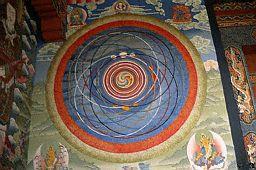 Vesna Wallace describes it in [9] as being dark green in the center,
and Meru's four sides have the four different colors {of the mandala}.
Vesna Wallace describes it in [9] as being dark green in the center,
and Meru's four sides have the four different colors {of the mandala}.
Around Mt. Meru circle the 10 planets; Sun, Moon, Mercury, Venus, Mars,
Jupiter, Saturn, Rahu (North node of the moon), Kalagni (South node
of the moon) and Ketu (a comet).
'The ultimate background of both the Oriental and the Occidental
storied heavens and pits of hell, with the world mountain between,
is the Mesopotamian concept of the architecture of the universe, where
there is an axial cosmic mountain symbolized by the ziggurat oriented
with its sides to the quarters, above which, in the highest heaven,
sits a supreme god, An, amidst a brilliant company of deities. ...
And the seven heavens of the planets revolved below, in stages, which
were represented by seven terraced stories on the mountainside, while
beneath the earth, in the abyss, the terrible goddess Ereshkigal,
of the Land of No Return, was approached through the seven gates...
The shape of the universe according to the Jains is of a colossal
human form, usually female, with the earth plane at the level of the
waist; seven hells beneath, in the pelvic area, legs and feet; fourteen
celestial stories above, in the chest cavity and shoulders, neck and
head; while soaring above, in the shape of an umbrella of luminous
white gold, is a place of unalloyed perfection, to which the soul
ascends when the last least taint of a trace even of heavenly attachment
has been burnt away through the practice of yoga....
No one cares at all whether such a vision, competent to lure the mind
and heart away from earth, corresponds, as science, to earthly fact.
The judgment of its truth and value is pragmatic: if it works (upon
the psyche), it is true enough.'
Joseph Campbell [5]
'The hells {taught in the Kalachakra} bear no resemblance to the
hells taught in standard Buddhist sources, such as Abhidharmakosa.
Neither do they correspond to those taught in standard Hindu sources
.... But they do correspond to those taught in standard Jaina sources.'
David Reigle [6]
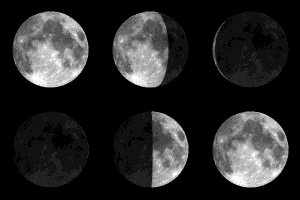 The
Kalagni disc represents the fire at the end of the eon. In the Sakya
tradition, Rahu and Kalagni are separate; in the Gelugpa tradition,
they are two aspects of the same "dragon" (like in Chinese and Greek
astronomy). Rahu is the head of the dragon, causing lunar eclipses,
Kalagni is the tail which causes solar eclipses.
The
Kalagni disc represents the fire at the end of the eon. In the Sakya
tradition, Rahu and Kalagni are separate; in the Gelugpa tradition,
they are two aspects of the same "dragon" (like in Chinese and Greek
astronomy). Rahu is the head of the dragon, causing lunar eclipses,
Kalagni is the tail which causes solar eclipses.
In Western astronomy, Rahu and Kalagni are called the north and south
nodes of the moon. When the sun and the moon are at these positions,
an eclipse occurs.
In Kalachakra, Ketu is a comet. Unfortunately, it often creates confusion
as Ketu is the name for the south node planet in the Hindu system.
'Rahu was an asura {half-god) who disguised himself as a god and
joined the line of gods waiting to receive a portion of nectar after
the great churning of the ocean. The Sun and Moon revealed the fraud
to Vishnu who cut off the demon's head; but immortal he lives in the
sky, intermittently wreaking vengeance on the sun and moon by swallowing
them. He is a dragon's head, the ascending node of the moon, the eighth
planet, an important luminary in the demonic sky.'
Keith Dowman [7]
For some great images and a detailed description of the Kalachakra
universe, see Edward
Henning's Kalacakra site.
It is important to remember the reason for explaining the Outer Universe
in a system of thought like Buddhism, which puts so much emphasis on
the inner, mental world in which the practitioner should find the path
to spiritual development.
"All the diverse models of the relations between the cosmos
and the individual that the Kalacakra tradition provides have a practical
purpose: they serve as devices for furthering one's understanding
of the interconnectedness of all phenomena and for training the mind
to perceive the world in a nondual fashion. Moreover, they are the
contemplative models with which one can diminish the habitual propensities
of an ordinary, dualistic mind. ...
The arrangement and movement of the planets in the sky influence the
body of the individual and correlate to the arrangement and flow of
the nadis in the body."
Vesna Wallace in [9]
Perhaps it is not unfitting to be reminded of a similar development
in modern science; a number of recent discoveries like the Special Theory
of Relativity and Quantum Mechanics do seem to lead to ideas not unlike
the Buddhist concept of emptiness:
Werner Heisenberg:
"What we observe is not nature itself, but nature exposed to our
method of questioning".
"...we never can know what actually goes on in the invisible subatomic
realm, and that, therefore, we should "abandon all attempts to construct
perceptual models of atomic processes".
Niels Bohr:
".. an independent reality in the ordinary physical sense can be
ascribed neither to the phenomena nor to the agencies of observation."
"Isolated material particles are abstractions, their properties definable
and observable only through their interaction with other systems."
"Quantum mechanics entails the necessity of a final renunciation of
classical ideas of causality and a radical revision of our attitude
towards the problem of physical reality."
David Bohm:
"Parts are seen to be in immediate connection in which their dynamical
relationships depend in an irreducible way on the state of the whole
system and the entire universe. Thus one is lead to a new notion of
unbroken wholeness which denies the classical idea of an analyzability
of the world into separate and independently existent parts."
Robert Oppenheimer:
"If we ask, for instance, whether the position of the electron remains
the same, we must say 'No'; if we ask whether the electron's position
changes with time, we must say 'No'; if we ask whether it is in motion,
we must say 'No'. The Buddha has given such answers when interrogated
as to the conditions of a man's self after death; but they are not
familiar answers for the tradition of 17th and 18th century science."
Albert Einstein:
"If there is any religion that would cope with modern scientific
needs, it would be Buddhism."
[1]: Introduction to Kalachakra, commentary by Dr. Alex Berzin June
28 - 30, 1985 at Institut Vajrayogini, France
[2]: Commentary given by Dr. Alex Berzin, Dharamsala 1992
[3]: Das Mandala by Martin Brauen
(Dumont 1992)
[4]: Commentary given by Dr. Alex Berzin, Maitreya Institute Holland
1984
[5]: Oriental Mythology by Joseph Campbell, Penguin 1962
[6]: Kalacakra Sadhana and Social
Responsibility, David Reigle, Spirit of the Sun Publications 1996.
[7]: Masters of Mahamudra by Keith Dowman, Suny 1985. (See nrs. 22,
24, 27, 46, 52, 54, 77)
[8]: Commentary given by Kirti Tsenshab Rinpoche December 1989, Bodh
Gaya India
[9]: The Inner Kalacakratantra,
Vesna Wallace, Oxford University press 2001

