|
Deities
of the Great Bliss (Mind) Mandala
THE
MIND MANDALA
The Mind Mandala actually consists of the
3 top levels in the center of the mandala, containing a total of 70 deities:
- the Enlightened
Great Bliss Mandala with Kalachakra, Vishvamata and 10 Shaktis
- the Enlightened
Wisdom Mandala containing the 16 Tathagatas
- the Enlightened Mind
Mandala containing the 24 Bodhisattvas, 8 Protectors (actually 2 pairs in
the list below belong to the Body Mandala) and 10 Offering Goddesses (of which
one is above and one is below the Mandala). Move your mouse slowly over
below Mind Mandala to see the names of the deities pop up.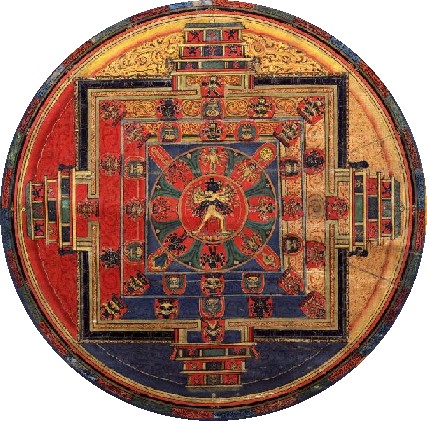 See also our Interactive Mandala
which shows the location of all deities in the full Body, Speech and Mind Mandala.
THE
GREAT BLISS MANDALA KALACHAKRA
AND VISHVAMATA
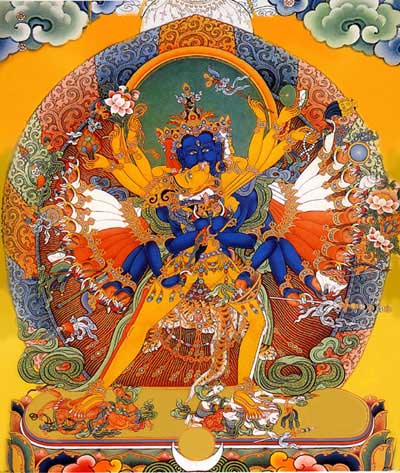 At the very center of the mandala is the Kalachakra deity. The
Kalachakra deity (dus 'khor in Tibetan) can be represented in several
forms; the most simple one is only Kalachakra with two arms and one
face, others can include his consort, Vishvamata, but most commonly
one can see the full aspected deity with four faces, twenty-four arms
and two legs, embracing Vishvamata At the very center of the mandala is the Kalachakra deity. The
Kalachakra deity (dus 'khor in Tibetan) can be represented in several
forms; the most simple one is only Kalachakra with two arms and one
face, others can include his consort, Vishvamata, but most commonly
one can see the full aspected deity with four faces, twenty-four arms
and two legs, embracing Vishvamata
"Vishva" means different aspects and "mata" is mother,
so it is the multiple-aspected mother.
As is usual in tantra, the male deity Kalachakra symbolizes method
/ bodhicitta / bliss and the consort Vishvamata (sna tshogs yum in Tibetan)
represents the wisdom of emptiness, ultimate truth. They embrace each
other to show the ultimate combination of method and wisdom, or bliss
and emptiness. In the Kalachakra context it refers to the Body of Empty
Form and Immutable Bliss. Vishvamata also symbolizes the wrathful aspect
of Kalachakra. .
It should be noted that there are slight variations in different traditions
to depict for example the arms and several other details.
To name only some of the symbolism contained in the arms and hands
of the main Kalachakra deity:
- The six collarbones refer to the six seasons (spring, hot
season, monsoon, fall [harvest], early winter and late winter, as well as the
six periods of the day and the night (Outer Kalachakra).
- The twelve shoulders
symbolize the two times six cycles of the breath (Inner Kalachakra).
- The
24 arms refer to the 12 black and 12 white moon phases of a year (the 12 waxing
and the 12 waning phases of the moon in Outer Kalachakra), and the 24 half periods
of the breath (Inner Kalachakra).
- Kalachakra has 360 bones and joints and
also 360 finger parts (three in each of the 5 fingers of the 24 hands which correspond
to the 360 days of the year and (Outer Kalachakra) and to the 360 periods of the
day which contain 60 draws of the breath each (Inner Kalachakra).
- Even the
colors of each finger have a deeper meaning: the yellow color of the outside of
the thumbs refers to the element earth, the white index finger refers to water,
the red middle finger refers to fire, the black ring finger to air and the green
pinks to space. The colors of the inside of the joints refer to the trinity of
Mind (black), Speech (red) and Body (white).
| |
|
|
|
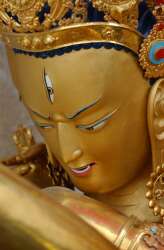
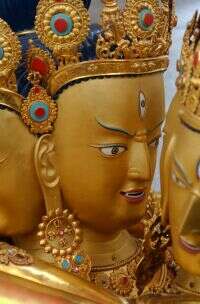
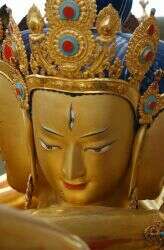
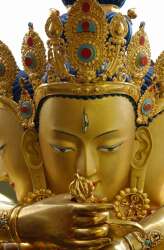
| Red, right, desire face |
Blue, front, wrathful main face |
White, left, peaceful face |
Yellow, rear, samadhi face |
| Click images to enlarge, they are quite
impressive! | Kalachakra
and Vishvamata confer the 'Vajra and Bell Initiation' (see Initiation).
The symbolism of the hand implements of Kalachakra refers actually to the
philosophy of the Samkhyas, Enumerators or Forders (living at the time of the
Buddha). They accepted 24 suchnesses which correspond to the implements as given
in below table:
| IMPLEMENT |
SUCHNESS | DEITY |
| vajra | fundamental principle | Akshobhya
(consciousness) | | | also space
element | Vajradhatu-isvari | | bell | urination
organ * | Ushnisha | | sword | wind | Tara |
| shield | body (tactile sense) | Sarvanivarana.Vishkambin |
| trident | sounds | Shabdavajra |
| kathvanga | mouth | Vighnantaka |
| curved knife | supreme organ * | Sumbha |
| skullcup (also moon disc) | I-principle
| Amoghasiddhi (compositional factors) | | arrows **
| eyes | Kshitigarba | | bow
| anus | Yamantaka | | hook
| tastes | Rasavajra | | lasso
| forms | Rupavajra | | dhamaru
| ear | Vajrapani | | jewel
| fire | Pandara | | hammer
| tangibles | Sparshavajra |
| lotus | water | Mamaki |
| Dharmachakra | earth | Locana |
| conch | legs | Padmantaka |
| spear | tongue (taste organ) | Lokeshvara |
| mirror (also Rahu disc) | mind (mental
organ) | Samantabhadra | | baton | smells
| Gandhavajra | | iron chain (also
sun disc) | intellect | Amitabha (discrimination) |
| ax | nose (smell organ) | Khagarba |
| Brahma's head | arms |
Prajñantaka |
Notes on above table:
* The
genitalia of the Samkhyas appear to be split into 2: urination organ and supreme
organ (sex).
**
Note that in the contemporary Gelug lineage, these are often called "three arrows', but 'fire-arrow' may be more correct, see this article by David Reigle.
The five Buddhas representing the five aggregates are unsure,
[9] suggests "citta" to be feeling/heart which would be Ratnasambhava; "buddhi"
would be discrimination or intellect, represented by Amitabha.
Only the "person"
of the total list of 25 principles of the Samkhyas is missing. Possibly this is
represented by Kalachakra himself {or Vairochana as form?}
Thus, the purified
form of these 24 elements are the implements and the purification of the "person"
may refer to Kalachakra.
The main
deity stands on Mara and Rudra to symbolize his victory over delusions:
Mara is a well-known figure in Indian symbolism, usually representing
delusions and the problems of samsara.
Here, the aspects of Mara can be divided
into: inner delusions; the aggregates; death; and the "outer Mara" -
the desire god Karma Deva. (The first three are the inner Maras; like the three
nectars in the bowl of Shakyamuni refer to.) Mara is holding 5 flower arrows in
the first right hand, which have interesting meanings: making happy; making to
want again; making confused; emaciating and killing. In his second right hand
is a hook, like Kalachakra is holding; in his first left hand a bow and in the
second left hand a lasso. Rati is the goddess of Mara and symbolizes the female
organ and sexual desire, she is trying to lift Kalachakra's foot to put less weight
on her consort. .
Rudra is also called Ishvara, Mahadeva or Shiva.
Rudra literally means "dreadful or terrible one". Uma, the consort of Rudra, (in
Tibetan "the middle way") is also known as: Parvati (Lord Shiva's wife), Dhurga,
Kali Ishvara or Palden Lhamo. The deities stand in the center of a lotus which
represents amongst other things, renunciation.
On top of the lotus are four
discs; a white moon disc for bodhicitta; a red sun disc for the realization of
emptiness, a black Rahu disc for immutable bliss, and a yellow Kalagni disc for
the empty form body.
THE
SHAKTIS
 |
|
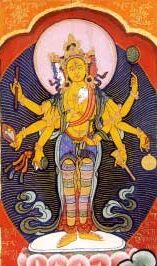
Shaktis are well known deities in Hinduism,
but in Buddhism they are found exclusively in the Kalachakra tantra.
As can
be seen on the left (this depicts Pitadipta or Balaparamita), the Shaktis are
depicted as women with one face, eight arms and two legs. Each one holds different
implements.
Eight of the ten Shaktis stand on the petals of the lotus in
the center of the mandala, surrounding Kalachakra and Vishvamata, the other two
are part of the main deity and not separately depicted in the mandala. Below table
summarizes some of the symbolism related to the Shaktis, although the table is
all but comprehensive and may contain mistakes. One of their main symbolic references
is to the main ten winds (energies) at the heart chakra; see also the page on Inner Kalachakra.
The Shaktis confer
the 'Silk Ribbon Inititiation' (see Initiation). |
| |
| PERFECTION |
OTHER NAME | | SANSKRIT |
TIBETAN | ENGLISH |
SANSKRIT | ENGLISH |
DIR. | WIND | | Dana | Duwama | Giving | Dhuma | Smoke | SE | turtle
| | Shila | Sigyuma | Ethics
| Marici | Mirage | SW | chameleon |
| Kshanti | Kanangma | Patience | Khadyota | Firefly | NE | devadatta |
| Virya | Marmema | Perseverance | Pradipa | Lamp | NW
| dhamnajaya *1 |
| Dhyana | Nagmo
barma | Concentration | Krishnadipta | Blazing
Black | E | fire-accompanying |
| Prajña |
Sherphyin | Wisdom | {Vishvamata} | | below
heart | downward voidng |
| Upaya | Darmo
barma | Method | Raktadipta | Blazing
Red | S | upward
moving | | Pranidhana | Karmo
barma | Prayer | Shvetadipta | Blazing
White | N | pervasive
*2 | | Bala | Sermo
barma | Power | Pitadipta | Blazing
Yellow | W | serpent/naga
|
| Jñana |
Yeshe
pharphyin | Exalted
Wisdom | {Vishvamata} | - | above
heart | vitalizing/life |
The 10 Shaktis, together with Kalachakra and Vishvamata also refer to 12 cycles
of the breath, the 12 signs of the zodiac and the 12 energy orbits around Mount
Meru. Together with the vases and the signs at the corners of the Great Bliss
Mandala, the Shaktis, Kalachakra and consort, represent the first 3 months of
an embryo, in which the three main energy channels, the 10 main winds and the
six cakras are formed.
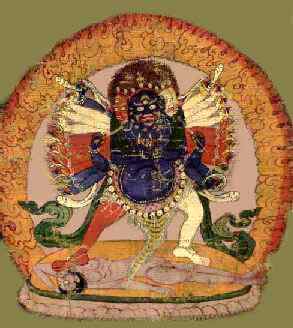 |
Vajravega (or Dorje Shug in Tibetan) represents the wrathful
aspect of Kalachakra himself.
Vajravega is without and looks similar to Kalachakra,
but is typically fat like most Protectors are depicted.
Vajravega has two
more arms than Kalachakra (right black and left yellow) which hold an elephant
skin like a cloak, but the other twenty-four hands hold the same implements. Interestingly
enough, Vajravega is not normally depicted in the Mandala. |
|