Different
Mandalas
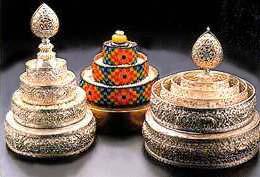
The Sanskrit word Mandala means Circle.
In Tibetan Buddhism, mandalas come
in two varieties; they can represent the conventional universe (see the image
left), as it is used for example in the Mandala Offering Ritual. Here one symbolically offers
the entire universe in the form of a mandala (circle) while reciting mandala offering prayers.
The type of mandala we will explore here more extensively represents (amongst many things)
the dwelling place of a specific Buddha-form or meditational deity.
THE
MANDALA PALACE OF MEDITATIONAL DEITIES
Each different meditational deity (Yidam) has their own specific mandala or palace which is often visualized in tantric meditational practice. These these mandalas/palaces are actually 3-Dimensional
buildings, usually with the main Buddha-form of the specific
practice in the center. In the Tibetan tradition, these mandalas can be represented as thangkas (scroll-paintings),
wall paintings, sand-drawings, or actual 3D models made of e.g. wood or metal.
A mandala is full of symbolic meaning and can be "read" and
studied like a text. The purpose of a mandala is to acquaint the student
with the tantra, and thus allowing the student to identify with the
central deity and its pure surroundings as the mandala.
His Holiness the Dalai Lama from: 'The
Kalachakra Tantra, Rite of Initiation':
Creating a two-dimensional Kalachakra mandala in colored sand of some
2 meters diameter means quite a lot of work, as all the dimensions and colors need to be accurately following the tradition. Also, many prayers
are made in the process, so it generally takes a team of monks about six days of
work to create a complete Kalachakra sand mandala. Producing an actual 3-D model is quite an undertaking. Therefore, 3-D mandala models are quite rare.
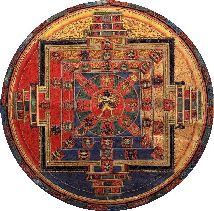 | 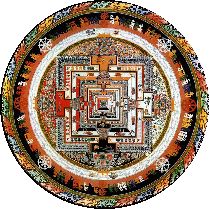 |
Painted
Kalachakra Mind Mandala | Full Kalachakra sand Mandala
|
For a Kalachakra initiation, one generally prefers to use a sand mandala, but a 2-D image can also be used.

